Monday, June 7, 2010

Cash ..Kasu..?!!

I come from the Southern state of Tamil Nadu, in India. I speak the language Tamil, which is considered one of the oldest languages in the world. India has had an ancient culture and a land invaded and ruled by quite a variety of European and Middle East rulers. After the invasion and rule by the British East India Company for centuries has resulted in an exchange of words from Indian languages to English and vice versa.
Global Currencies Royalty Free Stock Photo

Money is one of the most powerful tools invented by the modern man.I was intrigued  to find how the word cash originated.
From wiki :
The primary meaning of the word cash, paper money, or money in general, comes from Latin capsa, chest. A secondary meaning of cash, referring to any of various coins used in southern India and China, comes ultimately from Tamil காசு kācu (Source: OED, AHD, MWD)

Its a small world. Origin of words can lead us to so many amazing facts in History!I was excited to find that Cash is from a south Indian language Tamil.There are many Indian words in English and English has become a part and parcel of the urban Indian languages nowadays. I will be focusing on more such words in my future posts.

Wednesday, June 2, 2010

Nebulae, Jaguar...these are not constellations or animals ..but Supercomputers

Yes these supercomputers are the most powerful computers with an amazing processing speed calculated in FLOP's i.e Floating Point OPerations per second. The word that was new to me was PetaFlops.


Why are these supercomputers called supercomputers ?
It is because the Supercomputer can perform a trillion tasks per second. Their performance is measured in PetaFlops->Now, thats the word for the day.


The Rank 1 Supercomputer in the world ;
The top system is Cray's Jaguar supercomputer at the U.S. Department of Energy's Oak Ridge National Laboratory, which is a 1.76 petaflop system.
The Rank 2 Supercomputer in the world ;
The Nebulae, a 1.27 petaflop system, China


Now when we say 1.76 PetaFlops or 1.27 Petaflops what do we exactly mean? How big is this measure?


1 PetaFlop = thousand trillion floating point operations per second.


So you can now imagine how fast the super computers work!


Tuesday, June 1, 2010

Agatha ..the storm bought me back


I was busy with life and also with other blogs that I could'nt devote time to my first blog on words.
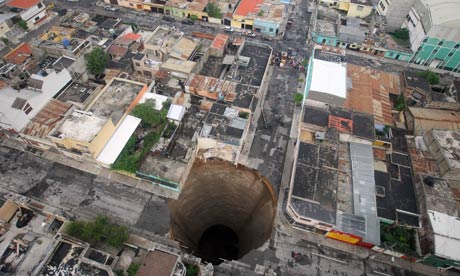
I was reading todays news and I was awestruck when i glanced on the picture of the sinkhole caused by storm Agatha , in Guatemala. Wow! that was a sinkhole i wouldn't forget in a lifetime. For the benefit of the readers in understanding my exaggeration about the sinkhole, I have a picture of the same sourced from the internet. Please have a look at the picture below.


The hole caused by the storm, where the earth has caved in is called a sinkhole.
There can be a couple of reasons for the sinkhole to be caused
A) The earth is made of  compounds like limestone that gets eroded due to underground water flow or due to seepage of rain water etc. This water dissolves the Calcium Carbonate making the earth brittle in these places.
This is one of the main explanations behind the formation of massive underground caves in the areas of Mexico and upper Southern American regions. When the earth can no longer take the pressure or if the limestone is depleted to a stage where the binding at the earth surface is weak, the earth just caves in and swallows all above it. The crater / well could be deep depending on the erosion levels or depending on the rock formations or soluble compounds present in these rocks.

B) Bad Urban design

To facilitate a sewage system or underground cables or a sub way transport system, the earths terrain below is altered or the course of an underground water system is changed as a part of urban planning.This might weaken the earths terrain and its unfortunate that when such storms or earthquakes occur, the earth just caves in.

Now thats about sinkholes for today!

Saturday, February 13, 2010

My weak spot..my achilles' heel?!

Achilles was a Greek warrior.He was known for his valor. It is believed that Achilles' mother dipped her son when he was born into the river Styx, to make him immortal. She held him by his heel while she dipped him.
Now, that became the weak spot for Achilles. He was a famous warriors whose victory knew no bounds untill he got shot in his heel by Prince Paris in the war of Troy.
So, to refer anybody's weak spot we use the term Achilles' heel!
Example : His greed is his Achilles' heel. It will destroy him.

Sunday, October 25, 2009

Halcyon

Just means tranquility and peace.Its actually a greek word for the mythological bird halcyon.As a noun it implies this bird of ancient Greece ,that nested on the seas and calming them with their magical powers.
When used as an adjective it means  tranquil, placid, calm or peaceful.
The kingfisher is called the halcyon.Scientific names for the Stork-billed Kingfisher Scientific name - Halcyon capensis and the White-throated Kingfisher's Scientific name - Halcyon smyrnensis etc.


The kingfisher also called the halcyon.


Halcyon Woodlands, a Halcyon summer

Generally the terms like good old halcyon days or the halcyon season is used in literature to imply a peaceful period.

Monday, October 19, 2009

Kettle Basin Brook Burn ...What are these?

During road trips, trails, camping experiences we always come across so many names for water bodies.All the words mentioned in the title are water bodies.I've always wondered the difference between them.Its nice to know what they actually mean and how a creek may be different from a brook etc.Below are some common water bodies with a small description..


  • Creek - a usually dry creek bed or gulch that temporarily fills with water after a heavy rain, or seasonally.
  • Basin - a region of land where water from rain or snowmelt drains downhill into another body of water, such as a river, lake, or dam.
  • Bay - an area of water bordered by land on three sides.
  • Billabong - a pond or still body of water created when a river changes course and some water becomes trapped. Australian.
  • Brook - a small stream.
  • Burn - a small stream.
  • Canal - a man-made waterway,
  • Channel - the physical confine of a river, slough or ocean strait consisting of a bed and banks. 
  • Creek - a small stream.
  • Creek (tidal) - an inlet of the sea, narrower than a cove.
  • Draw - a usually dry creek bed or gulch that temporarily fills with water after a heavy rain, or seasonally.
  • Estuary - a semi-enclosed coastal body of water with one or more rivers or streams flowing into it, and with a free connection to the open sea
  • Glacier - A large collection of ice or a frozen river that moves slowly down a mountain.
  • Harbor - a man-made or naturally occurring body of water where ships are stored
  • Inlet - a body of water, usually seawater, which has characteristics of one or more of the following: bay, cove, estuary, firth fjord, geo, sea loch, or sound.
  • Kettle - a shallow, sediment-filled body of water formed by retreating glaciers or draining floodwaters.
  • Lagoon - a body of comparatively shallow salt or brackish water separated from the deeper sea by a shallow or exposed sandbankcoral reef, or similar feature.
  • Lake - a body of water or other liquid, but usually freshwater, of considerable size contained on a body of land.
  • Loch - a body of water such as a lake, sea inlet, firth, fjord, estuary or bay.
  • Mangrove swamp - Saline costal habitat of mangrove trees and shrubs.
  • Marsh - a wetland featuring grasses, rushes, reeds, typhas, sedges, and other herbaceous plants (possibly with low-growing woody plants) in a context of shallow water. 
  • Moat - a deep, broad trench, filled with water, surrounding a structure, installation, or town.
  • Ocean - a major body of saline water that, in totality, covers about 71% of the Earth's surface.
  • Pool - a small body of water such as a swimming poolreflecting pool, pond, or puddle.
  • Pond - a body of water smaller than a lake, especially those of man-made origin.
  • Puddle - a small accumulation of water on a surface, usually the ground.
  • Rapid - a fast moving part of a river
  • Reservoir - an artificial lake, used to store water for various uses.
  • River - a natural waterway usually formed by water derived from either precipitation or glacial meltwater, and flows from higher ground to lower ground.
  • Run - a small stream or part thereof, especially a smoothly flowing part of a stream.
  • Salt marsh - a type of marsh that is a transitional zone between land and an area, such as a slough, bay, or estuary, with salty or brackish water.
  • Sea - a large expanse of saline water connected with an ocean, or a large, usually saline, lake that lacks a natural outlet such as the Caspian Sea and the Dead Sea. In common usage, often synonymous to ocean.
  • Spring - a point where groundwater flows out of the ground, and is thus where the aquifer surface meets the ground surface
  • Stream - a body of water with a detectable current, confined within a bed and banks.
  • Subglacial lake - a lake that is permanently covered by ice and whose water remains liquid by the pressure of the ice sheet and geothermal heating. They often occur under glaciers or ice caps. Lake Vostok in Antarctica is an example.
  • Swamp - a wetland that features permanent inundation of large areas of land by shallow bodies of water, generally with a substantial number of hummocks, or dry-land protrusions.
  • Tarn - a mountain lake or pool formed in a cirque excavated by a glacier.
  • Tide pool - a rocky pool adjacent to an ocean and filled with seawater.
  • Wash - a usually dry creek bed or gulch that temporarily fills with water after a heavy rain, or seasonally.

Tuesday, October 6, 2009

A steaming cup of coffee


What more refreshing than a cup of hot coffee.Coffee is a world famous beverage made from roasted coffee beans.The origins of the beverage is believed to be from Ethiopia.There are plenty of options in a coffee house.I wanted to know what each type actually meant to assist my taste buds in their choice.Thus, the article on the different coffee words and their meaning.
Hot Coffee Types
Espresso : Got by passing hot steam through roasted and ground coffee beans.Very strong. It is served hot in a small cup sometimes with cream. Espresso can be decaffeinated, medium strong or very strong depending on the country and coffee house.
CaffÈ Latte : Espresso with steamed milk forming a small topping of foam. It has less foam than a cappuccino
Cafe Breva :  Espresso with steamed half and half (cream).
Cappuccino : 1/3 Espresso (1 shot) 1/3 steamed milk and 1/3 foam. Cinnamon or flaked chocolate is sprinkled on top.
CaffÈ Mocha A latte or a cappuccino with chocolate syrup or hot cocoa. 
Cafe Macchiato: 4 parts espresso with 1 part steamed milk.
Black coffee: Coffee brew (liquor from passing steam through roasted beans ) with no milk.Strong.Can be had with or without sugar.
Americano: A single shot of espresso with about 7 ounces of hot water added to the mix. Diluted espresso.
Indian (Madras) filter coffee: Coffee brew from the south of India.Made from hot water pressurized through dark roasted beans powder in a traditional filter.Served with 3 parts coffee to 1 part milk or equal depending on region.
Irish coffee: Coffee brew with Irish whiskey and foam. Alcoholic coffee beverage.


Cold Coffee Types 
Frappe : Variation of cold espresso.coffee brew / instant coffee with sugar, water/milk and ice. Cold Beverage.
Iced Cappuccino : is a double shot of espresso over crushed ice with an two ounces of cold milk and milk froth.
Iced espresso :  is a double shot of espresso over crushed ice, with whipped cream.